

In an era where the smartphone is the primary digital gateway, mobile app development has evolved from simple coding to creating complex, interconnected digital ecosystems. Success in 2026 requires more than just functional code; it demands a strategic blend of performance, user-centric design, and advanced integration.
A. The Foundation: Native vs. Cross-Platform
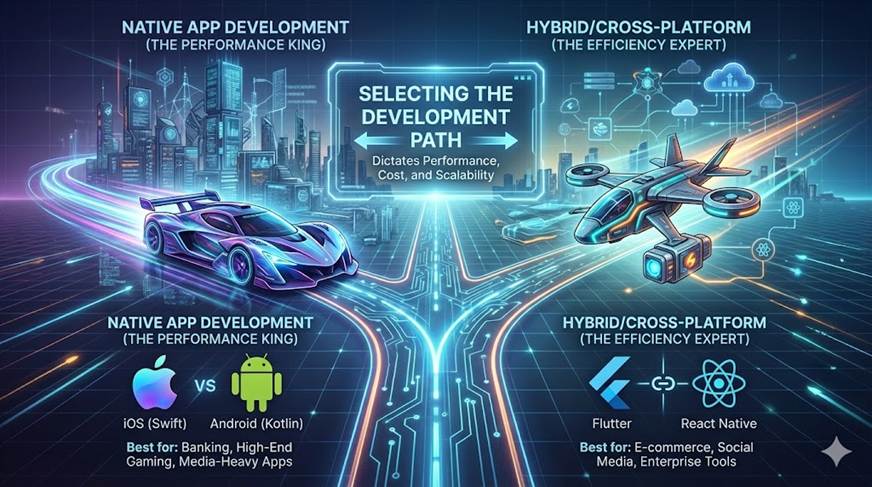
The first critical decision in any mobile strategy is selecting the development path. This choice dictates the app’s performance, cost, and long-term scalability.
- Native App Development (The Performance King): For applications requiring heavy computation, complex animations, or deep hardware access (like AR/VR), native development remains unrivaled.
- iOS (Swift): Offers robust security and seamless performance across the Apple ecosystem.
- Android (Kotlin): Provides flexibility and widespread compatibility for the diverse global Android market.
- Best for: Banking, high-end gaming, and media-heavy apps where lag is unacceptable.
- Hybrid/Cross-Platform (The Efficiency Expert): Modern frameworks have bridged the performance gap, making this the preferred choice for startups and MVPs (Minimum Viable Products).
- Flutter & React Native: These allow developers to write code once and deploy it on both iOS and Android. This drastically reduces development time and maintenance costs without significantly sacrificing user experience.
- Best for: E-commerce, social media, and enterprise internal tools.
B. Strategy & Design: The Growth Engine
Building the app is only half the battle; getting it discovered and retained is the other.
- App Store Optimization (ASO): Think of this as SEO for apps. It involves optimizing keywords, titles, and visual assets (screenshots/videos) to ensure your app ranks high in the Apple App Store or Google Play. High visibility drives organic downloads.
- UI/UX Design: Once a user downloads the app, the interface dictates retention. Modern Mobile UI/UX focuses on “thumb-friendly” navigation, dark mode compatibility, and accessibility. A polished prototype helps validate these flows before a single line of code is written.
C. Advanced Frontiers: IoT and Wearables
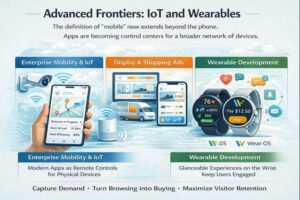
The definition of “mobile” now extends beyond the phone. Apps are becoming control centers for a broader network of devices.
- Enterprise Mobility & IoT: Modern apps are the interface for the Internet of Things (IoT). Whether it’s a logistics manager tracking a fleet or a homeowner controlling a smart thermostat, the mobile app serves as the remote control for the physical world.
- Wearable Development: With the maturity of WatchOS and Wear OS, apps now offer “glanceable” experiences. Health tracking, quick payments, and instant notifications on the wrist reduce screen time on the phone while keeping users highly engaged.
Conclusion
Mobile app development today is a multi disciplinary effort. It requires balancing the raw performance of Native code with the speed of Cross-Platform tools, while simultaneously designing for an ecosystem that includes Wearables and IoT. Businesses that treat their app not just as a utility, but as a central hub for user experience, will dominate the digital landscape.
